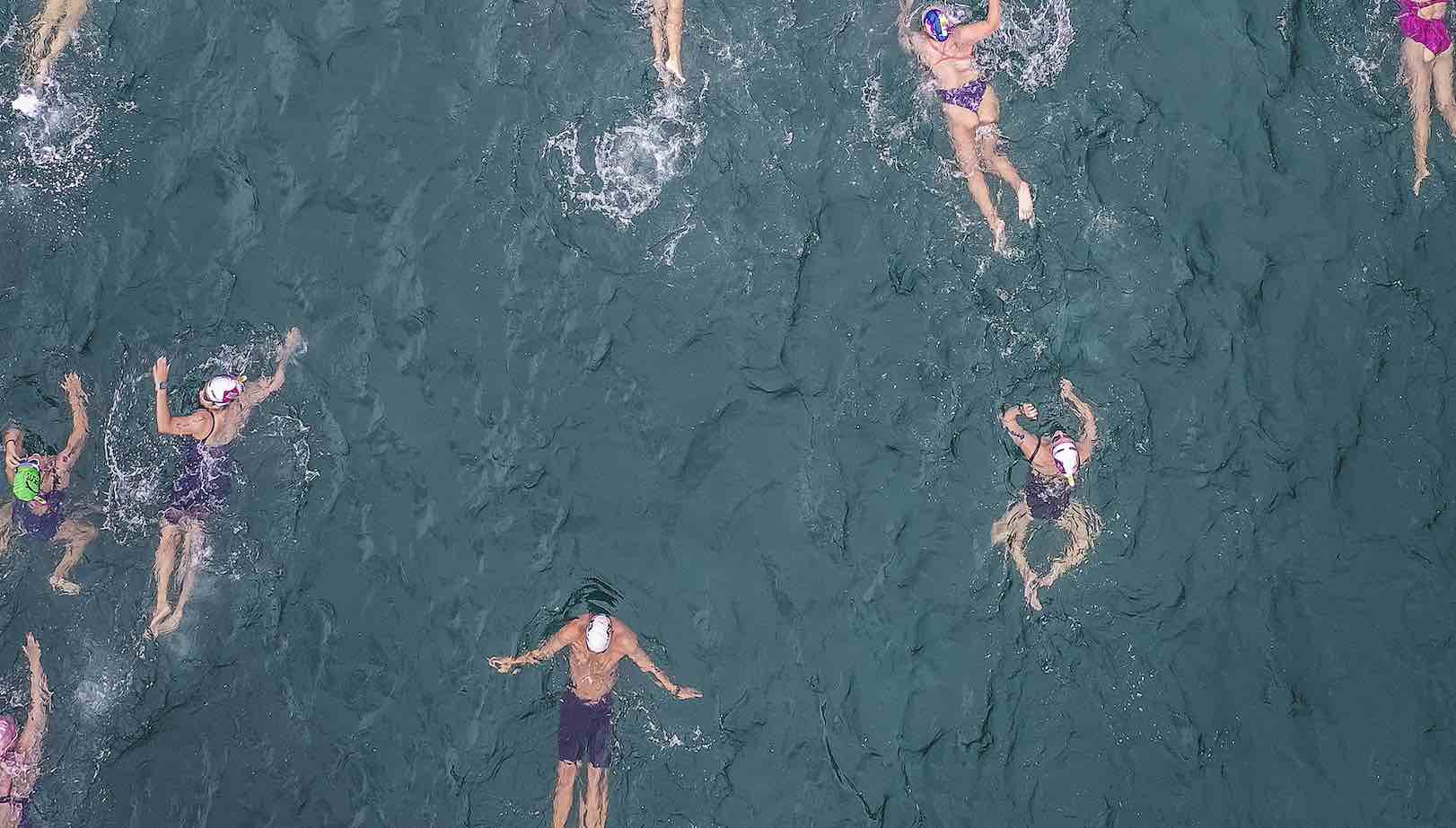
Hip drive is suitable for long distances and is relatively more energy-efficient compared to shoulder drive.
Catch (Hold Water)
Relax the shoulders, and form a resistance surface for pushing water with the inner side (the side not touched by the sun) of the entire arm. The push water resistance surface includes the inner upper arm, inner forearm, and inner palm. Keep elbows appropriately bent at about 100 degrees. Relax shoulders and armpits, but keep core (abdomen) tight, and maintain a straight body line.

The arm posture is similar to climbing a wall, with the elbow slightly higher. When energy is good, the catch can reach ear level; when tired, keep it lower.
Power Transfer
Hip rotation and kicking work together to drive the stroke. Hip rotation drives the kick, and the kick further provides support for the rotation (by pressing the entire thigh, calf, and instep against the water to support the same-side hip lifting).
The hip lifting further transmits through the torso to the upper body, driving the catching arm to swing backward.

The overall feeling of power transfer is similar to the image above. During power transfer:
- Keeping the abdomen (rectus abdominis, external oblique) moderately tense is critical, otherwise the rotational force gets absorbed by body twist.
- The joints on the power-generating side (shoulder on the catching side, hip on the kicking side) should be relaxed - relaxed to be able to swing out. During land drills, the center of gravity should be completely on the non-power-generating side.
The feeling while swimming:
- Hip rotates while the two legs exchange positions up and down to complete the kick. During kicking, the legs stay basically straight, with the inner thighs lightly touching to reduce drag.
- The upward-rotating hip, by pulling the latissimus dorsi, swings the catching arm backward, swings it out of the water, then swings it forward to form the entry position again. When swinging the arm backward, there’s also a feeling of the body rotation pulling the catching-side elbow inward.