
Diagrams extracted from the book “Underlying Logic: Seeing Through the World’s Bottom Line”. Explanations of the diagrams include my own understanding.
1. The Underlying Logic of Right and Wrong
1.1. Don’t Dwell on It
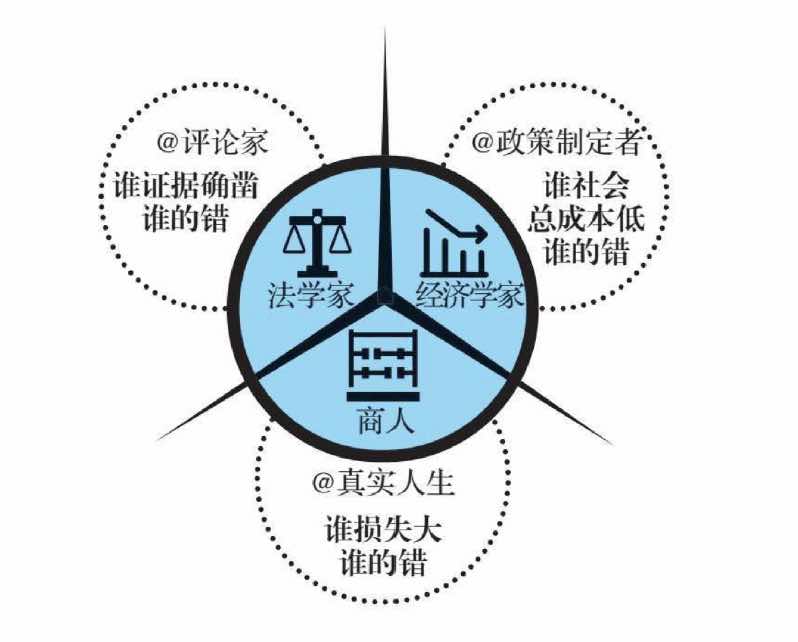
“Adults’ world has no right or wrong, only interests.” When you obsess over right and wrong, you’ve already missed the point. Don’t dwell, don’t纠缠. Laugh it off.
Jurists and economists are professions; they study right and wrong for academic research.
Ordinary people in life are the subjects of economists’ research, economically rational people, merchants. It would be too pedantic for merchants to analyze problems from the perspective of jurists/economists.
2. The Underlying Logic of Problem Solving
2.1. Elements and Relationships
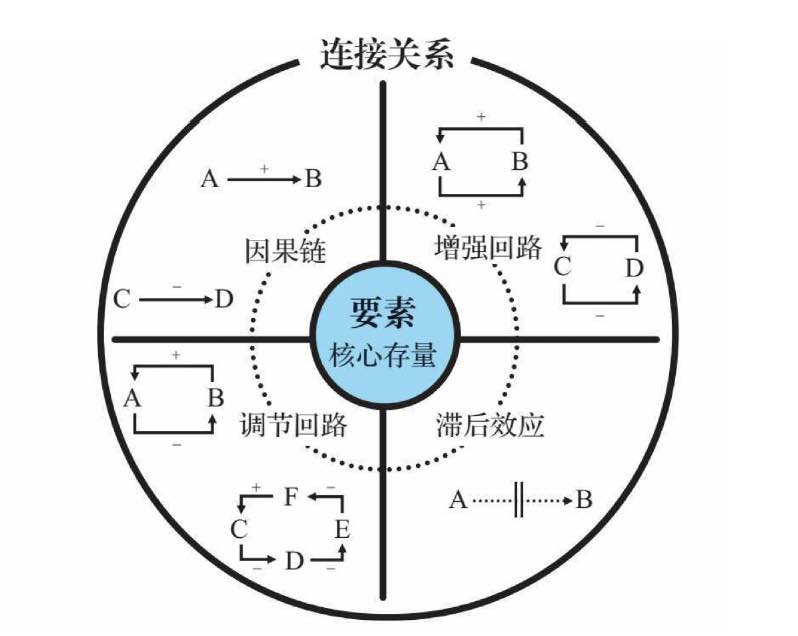
This diagram is about the composition of a system. It includes elements (a series of noun concepts) and relationships between elements.
For example, in a business system, there are elements like product, traffic, conversion, retention, profit, etc.
- Causal chain: Good product experience, increased retention
- Reinforcement loop: Good product experience → increased retention → increased profit → more R&D investment → even better product experience…, or reverse reinforcement: poor product experience
- Regulatory loop: Traffic increases to a certain point, product experience worsens
- Lag effect: There’s a lag between traffic increase and retention increase (the conversion process)
2.2. Logical Deduction
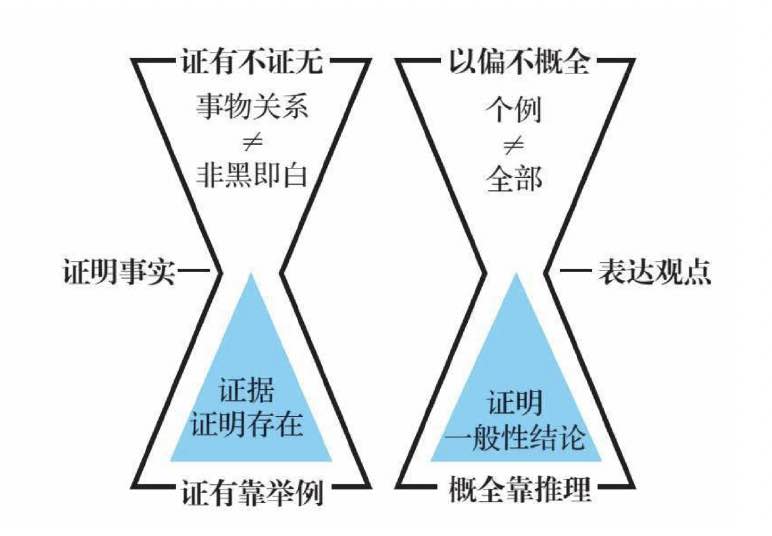
This diagram is about proving facts - prove existence, not non-existence; prove existence with examples. When expressing views, don’t overgeneralize. General conclusions can only be reached through proof and reasoning, not casual statements like “Isn’t this obvious?” or “Everyone thinks…”
2.3. Seeing the Essence
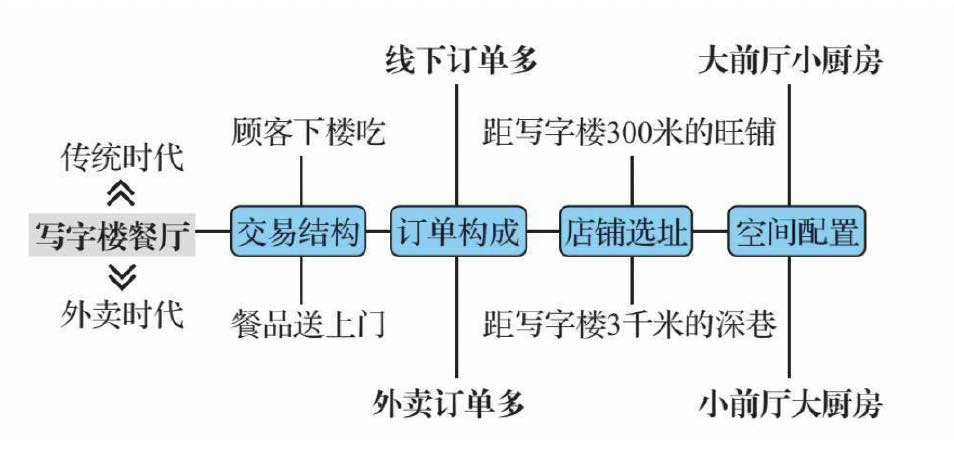
This diagram is about grasping the essence. Restaurants near office buildings have good business - the essence is traffic; being close means more traffic. When everyone starts ordering delivery, the traffic changes. Corresponding competitive strategies need adjustment. If you can’t grasp the essence, when traffic changes, simply focusing on food taste and service won’t help much.
The book has an example about Microsoft managing suppliers.
The company provides lunch and dinner for employees. More people usually eat lunch than dinner because not everyone works overtime at night, so lunch suppliers make more profit. It’s just that sometimes lunch is terrible… Imagine you’re the person in charge - how would you handle it? Send supervisors? Change chefs periodically? Ask them to update menus? Microsoft came up with a system:
- Select 2 suppliers, one for lunch, one for dinner;
- Every 3 months do a satisfaction survey: do you prefer lunch or dinner?
- If more people prefer dinner, swap the lunch and dinner suppliers;
- If lunch wins for 6 consecutive months, replace the dinner supplier.
The core of this system is introducing a competitive mechanism between lunch and dinner suppliers.
3. The Underlying Logic of Individual Evolution
3.1. Ability, Efficiency, and Leverage
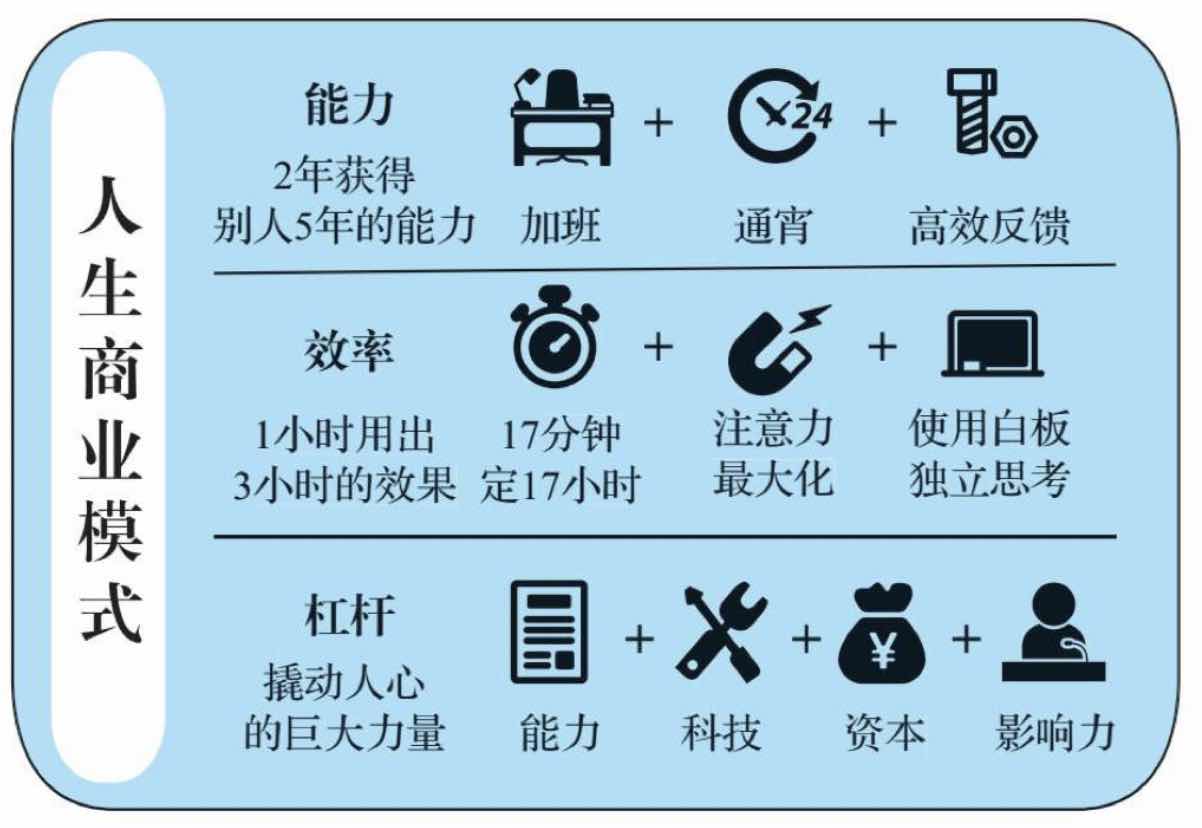
This diagram says that success in life’s business model is determined by the product of three factors:
- Ability: Requires time and energy investment, plus good methods (deliberate practice).
- Efficiency: Need to manage energy, make trade-offs, and have good tools.
- Leverage: Use the power of teams, technology, capital, and personal influence to amplify.
It particularly mentions that writing and speaking abilities are very important in personal influence.
3.2. Lower Your Posture
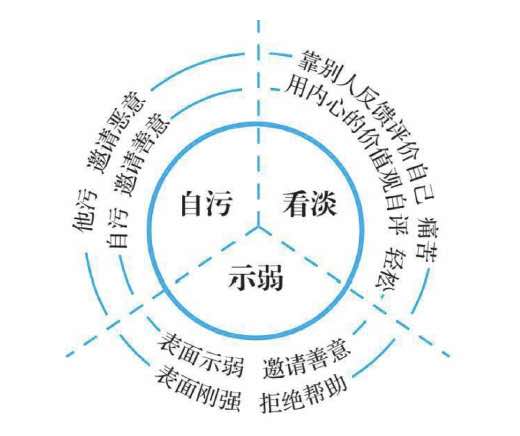
This diagram is about lowering your posture when communicating with others. This makes it easier to get help from others. Have an objective evaluation of yourself; don’t worry too much about others’ opinions.
4. The Underlying Logic of Understanding Others
4.1. Dopamine, Endorphins, and Serotonin
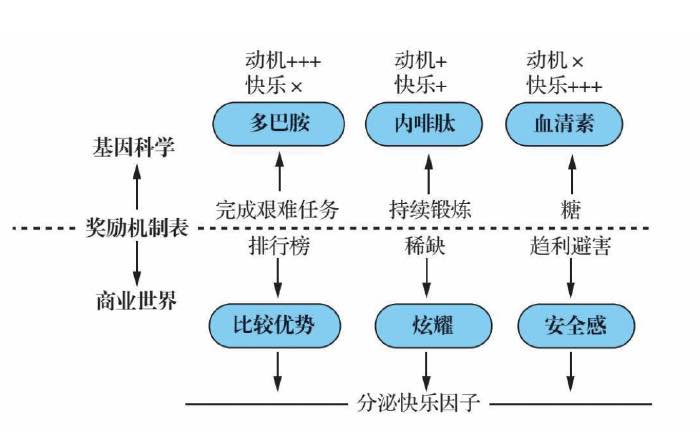
This diagram explains that physiologically, humans have three sources of pleasure:
- Dopamine: Comfort from satisfaction
- Endorphins: Exercise compensation
- Serotonin: Sense of security from carbohydrates and sugar
Corresponding to the business world, you can design reward mechanisms:
- Comparative advantage: WeChat step rankings, your boot speed beats 90% of users, giving users a sense of achievement
- Show off: Smart band app’s share to Moments feature, big LOGO on LV
Dopamine is a reward system for humans; it doesn’t directly produce pleasure but gives humans an expectation of reward - we can also call it addiction. Once humans become addicted to something, they can’t help but replicate it to get pleasure. In products, visualizing user expectations and presenting them in various ways can stimulate users to feel pleasure. A typical example is shopping carts.
Endorphins are substances that give you a sense of achievement; endorphin production is very stingy - it requires a lot of hard work and effort to possibly produce and give a sense of achievement. Applying this to products means building an achievement system for users, with three key points:
- Set some challenges for users;
- Strongly display these achievements in the product;
- Leverage some real-world achievements and project them into the product.
Dopamine is a substance produced when people satisfy their needs, generally having significant impact on mood. Endorphins are “sweet after hardship” substances, generally produced after the body experiences pain; people who don’t exercise regularly are more likely to produce them.
While both endorphins and serotonin promote mood, serotonin has a smaller impact, causing happiness and security. The pleasure from endorphins is stronger, depending on the amount of endorphins in blood flow, producing feelings similar to ecstasy and happiness. Endorphins at low levels can also produce slight relaxation and happiness, somewhat similar to serotonin’s effect.
Serotonin secretion is greatly affected by food intake and can be induced by carbohydrate-based foods (like pasta and grains). Releasing serotonin after eating these starches produces calmness, comfort, and health. After overconsuming carbohydrates, too much serotonin is released making the eater feel sleepy. However, lack of serotonin can cause stress, anxiety, frustration, and aggression, somewhat similar to endorphin deficiency. While some drugs can induce serotonin secretion, they are easily addictive. This is also why the body craves starchy foods or drugs when serotonin levels are low.
5. The Underlying Logic of Social Collaboration
5.1. Career and Short-term Interests
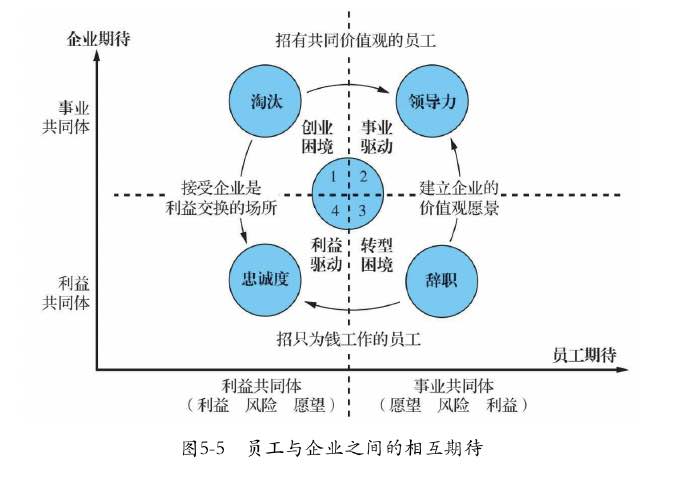
This diagram is about the relationship between employees and companies. The X-axis is employees’ actual views on long-term interests (career) and short-term interests. The Y-axis is the company’s expectations for employees.
- First quadrant: mostly startup companies; companies have dreams but hire employees who mostly focus on short-term returns.
- Third quadrant: companies are mature, less attractive to ambitious employees.
- Second quadrant: for example, housekeeping companies. “Don’t talk about beautifying the city, pay by the hour.”
- Fourth quadrant: employees identify with their current industry, and the company’s state has prospects, willing to struggle together with the company. Including giving up short-term interests.
Different types of companies need clear positioning - whether to operate in the second or fourth quadrant.
5.2. Sources of Profit
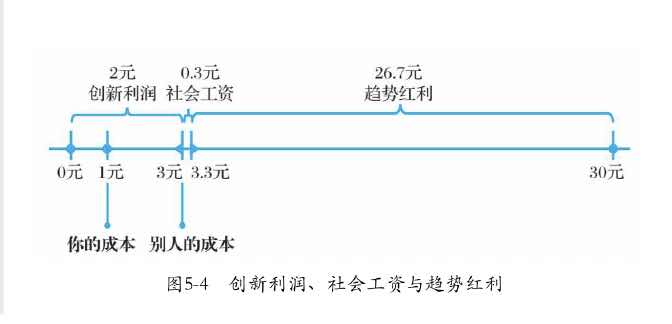
This diagram explains the three components of profit:
- Trend dividends won’t last, gradually disappearing as followers enter.
- Social wages are generally thin, hard-earned money.
- Only innovative profit has a chance to make money.
This diagram also echoes the principle of wealth distribution. The weight of wealth distribution depends on scarcity (trend dividends are because fewer companies enter; innovative profit is because only you can reduce costs through innovation).
6. Other
The book also mentions:
- Exponential growth: Requires making products with zero marginal cost.
- Fairness and efficiency: Why does the country do redistribution, why protect vulnerable groups…
- Long-termism: Do things that can accumulate
- Game theory: Decisions that affect others require considering game theory.
- Potential energy: To counteract the lucky element of success, follow the trend (be in an industry at the right time), grasp key directions (strategy)
- Contacts: Depends on people you can help, not people who can help you. “Be useful.”
- What, Why, How: Understanding the reason (WHY) enables unity of knowledge and action
- …
The book as a whole doesn’t have strong coherence from front to back; it’s a collection of articles. But it’s still a good points. book with many knowledge