
- What is NFT? What is DAO? DeFi? GameFi? SocialFi?
- What’s in a blockchain wallet?
- What opportunities does Web 3 present for companies? What opportunities for programmers?
- Why can the US block Russian users’ crypto transactions?
1. Web1, Web2, Web3
- Web1: Main application is creating websites to publish information.
- Web2: In addition to Web1, there’s interaction. Consumers of information also create content, which is consumed by platforms (viewing ads to generate revenue for platforms).
- Web3: Combines the decentralization and community management of Web1 with the rich interactive features of Web2. The biggest feature is that users and developers can own content. Web3 is token-driven.
According to Chris Dixon @ a16z, Web3 is a network jointly owned by developers and users, driven by tokens.
- Web1 (roughly 1990-2005) was about open protocols that were decentralized and community-governed. Most of the value accrued to the edges of the network — users and builders.
- Web2 (roughly 2005-2020) was about siloed, centralized services run by corporations. Most of the value accrued to a handful of companies like Google, Apple, Amazon, and Facebook.
- Web3 is the internet owned by the builders and users, orchestrated with tokens. … combines the decentralized, community-governed ethos of web1 with the advanced, modern functionality of web2.
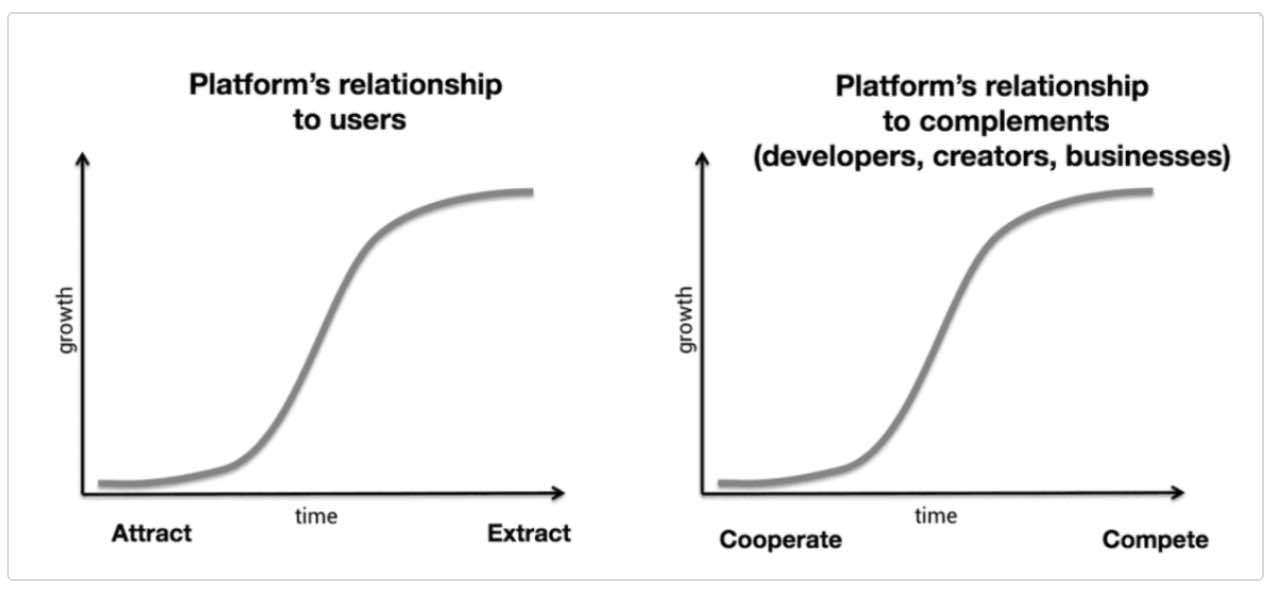
The above diagram describes the main problem of Web2, which is determined by the nature of central nodes (Google, Apple, Amazon, FB, etc.) pursuing profit. They give benefits to users and partners in the early stage, then consume user data later and compete with partners.
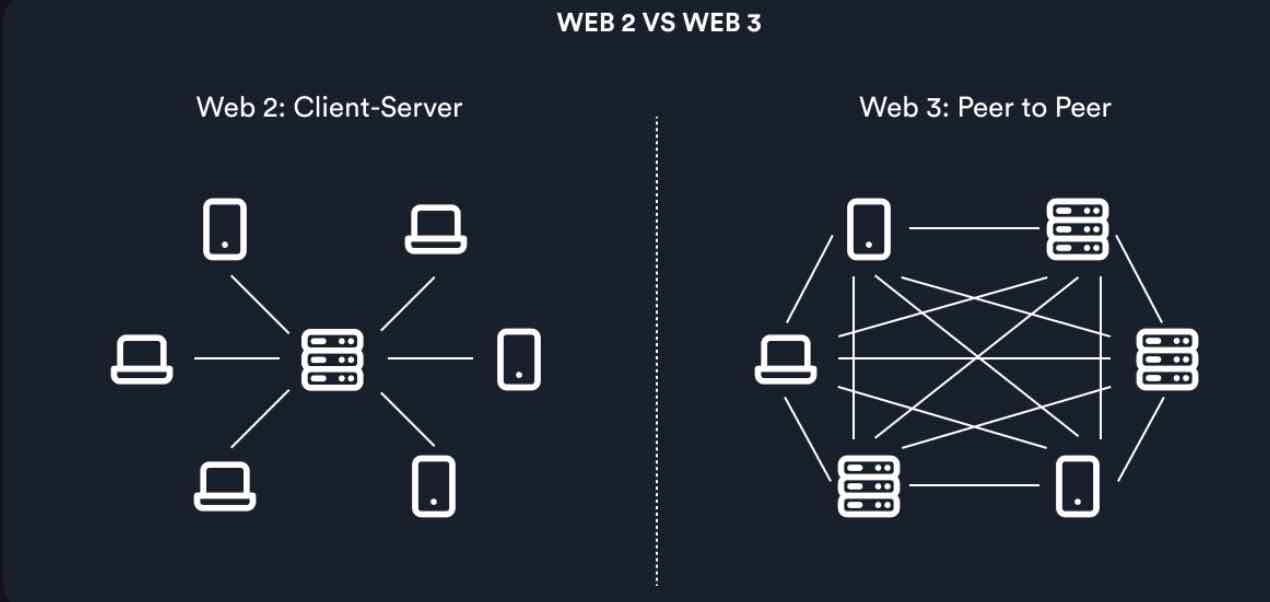
In terms of network structure, Web3 is peer-to-peer and decentralized.
2. Core Concepts
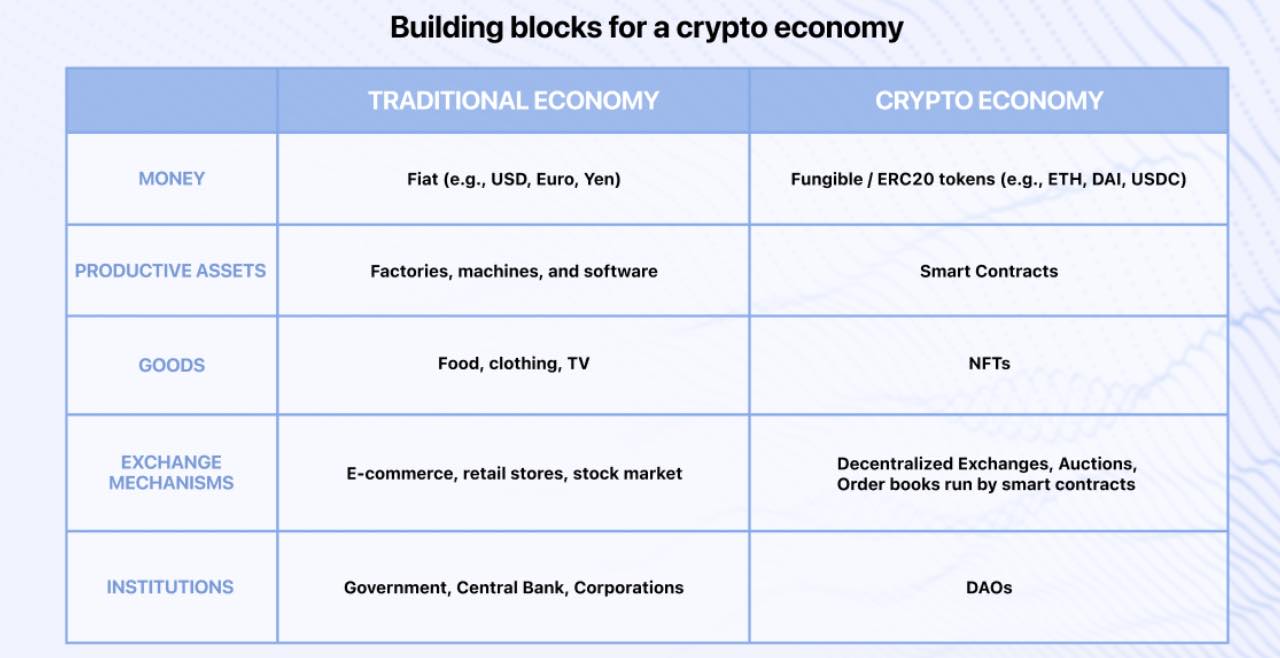
The above diagram compares major concepts in Web3 with major concepts in the real economy.
In real life, there are five types of entities that play roles in economic activities:
- Money: Without money, exchanges have no liquidity, we’d have to rely on much less efficient barter trade.
- Means of production (land, factories, machines, etc.): Without means of production, there are no goods.
- Goods: Without goods, there’s no economy.
- Exchange mechanisms (e-commerce, retail stores, stock exchanges, etc.): Without exchange mechanisms, goods are hard to trade, making division of labor impossible.
- Institutions (governments, banks, companies, etc.): Without institutions, coordination and cooperation between different economic participants would be difficult.
In internet-native economic activities (Web3), there are corresponding basic concepts:
- Cryptocurrency: Token / Crypto
- Smart Contracts: Smart Contract
- Non-Fungible Tokens: NFT
- Exchanges: Exchanges
- Decentralized Autonomous Organization: DAO
2.1. Token and Crypto
Token. It’s a string. A token is a record of ownership of an asset.
There are fungible and non-fungible types. Fungible tokens can be cryptocurrency, or money in real life. Your 1 Bitcoin and my 1 Bitcoin are equal in value, replaceable.
Non-fungible token is NFT.
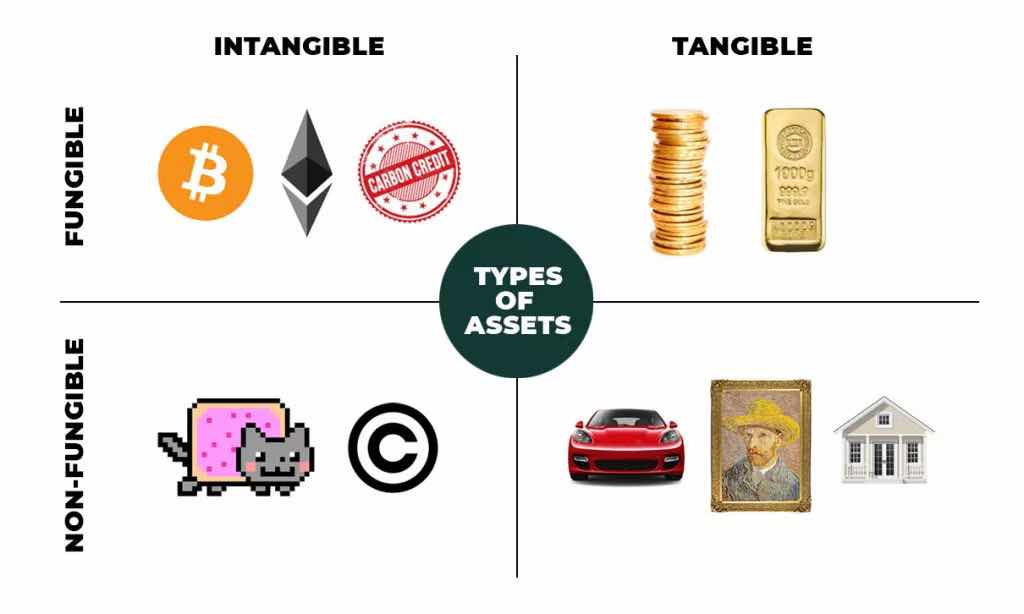
The above diagram classifies assets in the real and virtual worlds from two dimensions: tangible and fungible.
2.2. Smart Contract
Public contracts that everyone can see. Pre-set execution conditions that automatically execute when met. Smart contracts run on public blockchains and are open-source code natively integrated with crypto tokens. They allow developers to build complex applications across games, social, financial services, etc. Smart contract source code is public, and execution results are recorded on the blockchain.
Smart contracts are written in Solidity, for Ethereum applications. Syntax similar to JavaScript; there are development tutorials online.
Solidity is a statically-typed curly-braces programming language designed for developing smart contracts that run on Ethereum.
2.3. NFT
Short for Non-fungible tokens. Chinese translation is “非同质化代币” (unique token), which is ownership certification. It has the characteristics of non-fungibility, indivisibility, and transparent transaction history.
Mainly solves the problem of asset certification. Currently, in the real world, centralized organizations do asset certification. For example, the state uses property certificates to certify your property, game companies use records in databases to certify equipment you own in games. Using NFT is a decentralized way - assets can be certified and traded.
A way to represent anything unique as an Ethereum-based asset. NFTs are giving more power to content creators than ever before. Powered by smart contracts on the Ethereum blockchain. The above definition comes from Ethereum; actually any smart contract platform can support publishing NFTs.
NFT is certification of content. To participate in NFT, you need:
- Wallet (account, owner)
- Cryptocurrency (to pay gas, certification fees): Can be obtained by buying ETH from exchanges
- Issuance and trading platforms
Currently, NFT trading is mainly done on OpenSea, the largest market.
Why are people willing to spend money to buy ownership of a digital small image?
- After buying an NFT of an artwork, others who can see the artwork can also take photos or clone it digitally. NFT can’t prohibit copying. But NFT can prove you’re the owner. In the virtual world, only you are the owner of this image; only you can legally hang this image in your virtual home or use it in your own logo.
- With scarcity and demand, there’s buying desire. The core of buying and selling is ownership transfer.
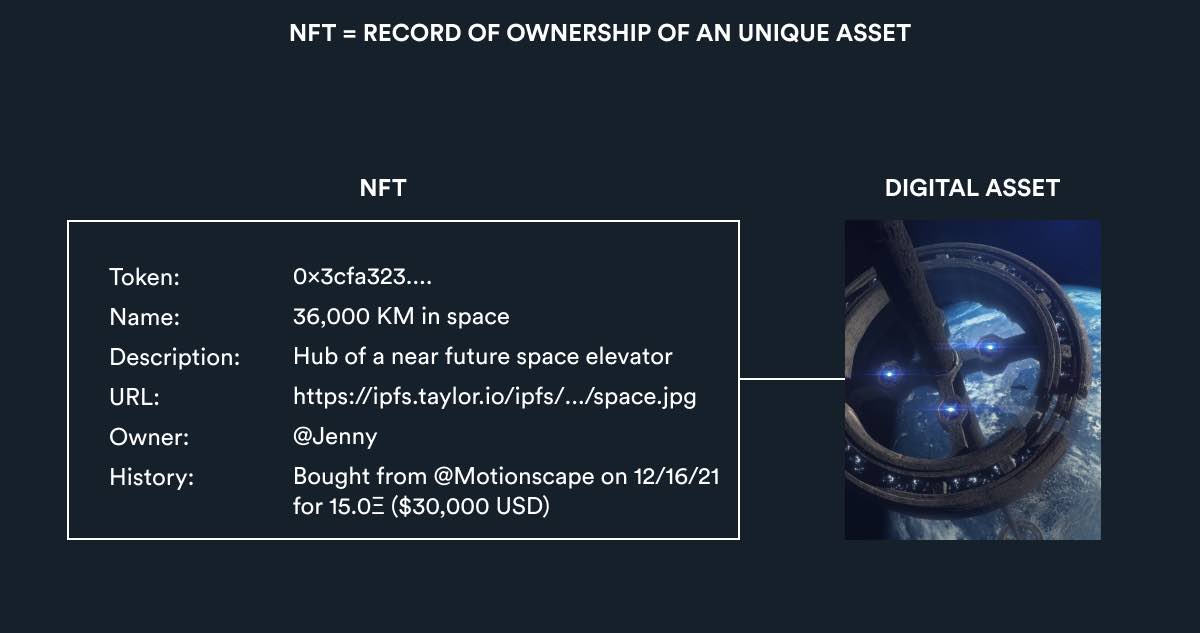
The above is an example of an NFT. The corresponding asset (image) here is stored on an external server. Some NFTs also store assets directly on the chain.
2.5. Exchanges
There are two types: centralized and decentralized. Centralized ones like Binance, Coinbase, etc. Regulated by their respective countries.
Representatives of decentralized exchanges:
- Uniswap (a crypto trading protocol)
- OpenSea (peer-to-peer market for NFTs)
They are similar to the impact of stock exchanges, retail stores, or e-commerce on the traditional economy:
- At stock exchanges you can trade traditional stocks; at Uniswap you can trade cryptocurrency (without centralized intermediaries like Coinbase or Gemini, Binance).
- At Walmart, Amazon, eBay you can buy physical goods; at OpenSea you can buy crypto-native digital goods.
2.5. DAO
DAO is a decentralized organization, a decentralized version of traditional companies, allowing participants to own projects and make collective decisions using smart contracts. It’s a new way to finance projects, manage communities, and share value.
Traditional companies own means of production (factories) and produce traditional economic goods (food, cars); DAO ultimately owns means of production and produces digital goods in the Web3 ecosystem.
DAO: Decentralized Autonomous Organization - a form of organization similar to companies. More transparent than traditional companies because anyone can view all actions and fund flows in the DAO. This greatly reduces corruption and censorship risk. Listed companies must provide independent audited financial statements, but shareholders can only see a snapshot of the organization’s financial health. Since DAO balance sheets exist on public blockchains, they are completely transparent at all times, down to every transaction.
Bankless is a currently well-running DAO that provides banking services for people without bank cards. They have weekly meetings on Discord. Has goals and incentives.
Odyssey DAO compares DAO with real-world companies:
- Organizational structure
- Company: Hierarchical structure led by CEO and other executives.
- DAO: Flat structure led by a group of core contributors.
- Decision making
- Company: Management approves proposals and makes decisions behind closed doors.
- DAO: Members publicly submit proposals and vote using DAO tokens.
- Onboarding
- Company: Candidates need to apply and pass interviews to be hired.
- DAO: Some DAOs allow anyone to join, others require a minimum number of tokens. Tokens can be bought or earned by contributing to the DAO (e.g., taking meeting notes).
- Career advancement
- Company: Employees need to continuously grow and get promoted.
- DAO: Members gain trust of core contributors through contributions.
- Compensation
- Company: Most employees work full-time and get paid through salary and stock.
- DAO: Most contributors work part-time and get paid through DAO tokens or other cryptocurrencies (e.g., stablecoins).
3. Wallets and Accounts
In Web3 practice, wallet is also an important concept, easily confused with addresses and accounts.
3.1. Wallet, Address, and Signature
A blockchain wallet is similar to a physical wallet. It can hold multiple bank cards issued by different banks (accounts on different chains). Each account (except contract accounts) is essentially protected by an asymmetric key system. Public keys are used to publicly receive information; private keys are used for authorized signatures.
If I use a certain account to transfer to another address, I need to sign the transfer information with the private key of the sending account, then attach the public key of the sending account. The system can use the public key and signature to determine if the transfer is approved by me (the account owner).
Mnemonic is a concept introduced to conveniently record private keys. The BIP39 specification defines how to generate private keys from mnemonics. Public keys can be calculated from private keys; addresses are a concept introduced for convenient use of public keys. Addresses are generally derived by performing hash operations on public keys.
So having a mnemonic is equivalent to having a private key. Having a private key means having everything. You can calculate the public key from the private key, then calculate the address from the public key.
Address formats may differ across chains. Ethereum starts with 0x, Bitcoin address formats have different notations (starting with 1, 3, bc1…). A wallet can use the same set of mnemonics to generate different public/private keys for different chains. This way, you only need to remember one set of mnemonics to conveniently have accounts on multiple different chains.
| Blockchain Wallet Concepts | Real-world Bank Account Concepts |
|---|---|
| Private key | Bank card password + bank card |
| Mnemonic (simplified private key) | Simplified bank card password |
| Public key | Bank account number |
| Address | Bank card number |
| Keystore | Encrypted private key |
| Wallet | Card holder |
Wallets can be classified in multiple ways:
- Centralized wallet (issued by exchanges, requires KYC) and decentralized wallet
- Cold wallet (not connected to internet) and hot wallet (app)
3.2. Accounts
Bitcoin doesn’t have the concept of account balance; the blockchain records one transaction at a time. Balances are obtained by tracing historical transactions.
Ethereum has two types of accounts:
- Externally Owned Accounts (EOA), controlled by keys.
- Contract Accounts, controlled by smart contract code.
Externally owned accounts include:
- A random number: actually a sequence number, incremented with each transaction to prevent replay attacks.
- Account balance
Contract accounts add to external accounts:
- Contract code: stores compiled EVM contract code. Once generated, it’s immutable, meaning smart contract code cannot be modified.
- Storage
Like external accounts, contract accounts also have addresses. Full nodes in Ethereum record all account states (including balances).
- Transactions can be viewed as messages sent from one account to another, which can contain binary data (payload) and Ether.
- If the target account contains code, the code runs in EVM with payload as input - this is contract invocation.
- When contracts are triggered by transactions, instructions run on every node in the network: this requires computing cost; each instruction execution has a specific cost, gas is used to quantify this cost.
- Once created, each transaction prepays a certain amount of gas to limit the work required for execution and pay for transaction fees.
4. Applications
Main directions:
- DeFi: Decentralized Finance
- GameFi: Game Finance
- SocialFi: Social Finance
DeFi (decentFinance) refers to financial services that run on smart contracts instead of relying on middlemen such as banks or exchanges.
In fact, existing Web2 applications all have opportunities to evolve to Web3. For example, if we make a Web3 improved version of Zhihu (Chinese Q&A platform). After improvement, what’s the difference from current Web2 applications?
- Advertising value can be shared with content creators.
- Display and ranking will be decided by voting, not by editors.
- Revenue is in platform tokens.
- Profit distribution and governance structure will change. For example, introducing smart contracts, after publishing, Zhihu itself cannot change them - fairer.
5. Ecosystem
5.1. Which Chain to Develop On?
There are two main types of chains currently:
- Ethereum: Similar to iOS, most rich ecosystem.
- Cosmos: Similar to Android
Most activities are around Ethereum or Ethereum-compatible chains. NFT, various DAO organizations are all based on Ethereum. There are many Binance Chain (BSC) users in China; Binance Chain depends on Binance exchange. It’s a copy of Ethereum. Compatible with Ethereum language; Ethereum programs can easily port to BSC. Bitcoin originally also has a scripting language but it’s quite weak. Bitcoin’s chain is basically a decentralized ledger.
- BSC is called the Chinese “retail chain” (ponzi). Relatively cheap.
- Ethereum: Testing gas fees are high. 20 USD - 100+ USD.
During development, you can apply for test chains on BSC/Ethereum.
Currently infrastructure is still early; it may not follow the pattern of mobile operating systems where iOS and Android dominate. Multiple chains may run synchronously in the future.
5.2. Development Tools
- Frontend: Solidity (smart contracts)
- Chain, infrastructure: Mainly Golang, Rust, C++ (underlying chain algorithms), Python also used.
web3.js is a collection of libraries that use HTTP or IPC to interact with local or remote Ethereum nodes.
Implementation of smart contracts needs to consider:
- Gas fees for each transaction
- Security
6. Opportunities and Challenges
6.1. Challenges
- Environment and ecosystem: Currently in China there’s no widely recognized public chain. Major giants each have their own chains, but essentially they’re all clones of Ethereum, running in their own IDCs. Not decentralized. Need a credible public blockchain that can economically, quickly, and environmentally process chain transactions.
- Technology: POW-based approach causes large computational volume, not environmentally friendly. Transaction speed is reduced.
- Laws and regulations: Since decentralization inherently conflicts with regulation, there are currently no good laws, regulations, or supervision policies. This brings uncertain risks for the future.
6.2. Opportunities for Companies
Currently, Web3 is in its early stages:
- Many Web2 applications will gradually migrate to Web3
- In infrastructure, it’s a fragmented landscape
6.3. Opportunities for Developers
- Smart contract development and blockchain-related development are hot areas.
- There are also many new DAO organizations that distribute rewards based on work. You can join popular open source project DAOs, have opportunities to get airdrops, and earn tokens through contributing.
6.4. Opportunities for Investors (Speculators)
Investing in cryptocurrency, NFT works, stories of overnight wealth are many on YouTube.
7. FAQ
7.1. What is mint?
Minting is the act of artists or collectors (project parties and users) initially issuing NFTs on the blockchain. It’s recording a token ID and its owner’s address on the blockchain.
7.2. What is the metaverse?
Different institutions have different definitions; some see it as the ultimate version of Web3. Some just see it as enhanced virtual reality.
7.3. Why can the US sanction Russian Bitcoin investments?
Related reports:
Recently, Coinbase, the largest US cryptocurrency exchange, said it has blocked more than 25,000 wallet addresses related to Russian individuals or entities, believing these individuals or entities engaged in illegal activities. According to 2021 data, the blocked wallet addresses represent 0.2% of Coinbase’s 1.4 million monthly trading users. Additionally, Coinbase shared these wallet addresses with the US government to help enforce sanctions, including prohibiting some Russians and companies from financial transactions.
The reason:
- Coinbase is a centralized exchange regulated by the US, does KYC, can block Russian users
- Similarly, Binance is also a centralized exchange, does KYC on customers, can block Chinese users
From reports, Coinbase can identify Russian customers through its KYC data, then prohibit such customers from using Coinbase services. “Blocked wallet addresses” means cannot transfer crypto in or out of these wallet addresses through Coinbase. But the assets in those wallet addresses still exist. They can still trade in decentralized ways or on other exchanges.
7.4. How is the total number of Bitcoin estimated?
It’s calculated based on block rewards. A block is generated every 10 minutes, initially each block rewards 50 BTC, after 4 years 25 BTC, halving every 4 years. So approximately 21 million in total.
Later in mining, each block reward decreases, but miners can still get commissions from each transaction in the block. So there’s still incentive to mine.