
What is Pip?
Pip is the quoted unit for exchange rate changes. Generally the fourth decimal place. 0.0001 is one pip. Yen is an exception - for Yen, 0.01 is one pip. Because Yen is too small.
A pip is a unit of measurement for price movements of currencies in foreign exchange (FX) markets. Pip stands for “percentage in point” or “price interest point.” It represents the smallest price variation that a particular exchange rate experiences based on typical FX market convention.
Pip represents absolute numbers, not return rates
Suppose you have $10,000 USD, and USDCNY is quoted at 6.5, then you can exchange for 65,000 RMB. Assume the exchange rate increases by 100 pips (0.0001 × 100 = 0.01), becoming 6.51, then you can exchange for 65,100 RMB. A 100 pip exchange rate change caused you to gain an extra 100 RMB.
Knowing the total transaction amount and the exchange rate change, you can determine the change in profit. But you don’t know the return rate (the proportion of profit change).
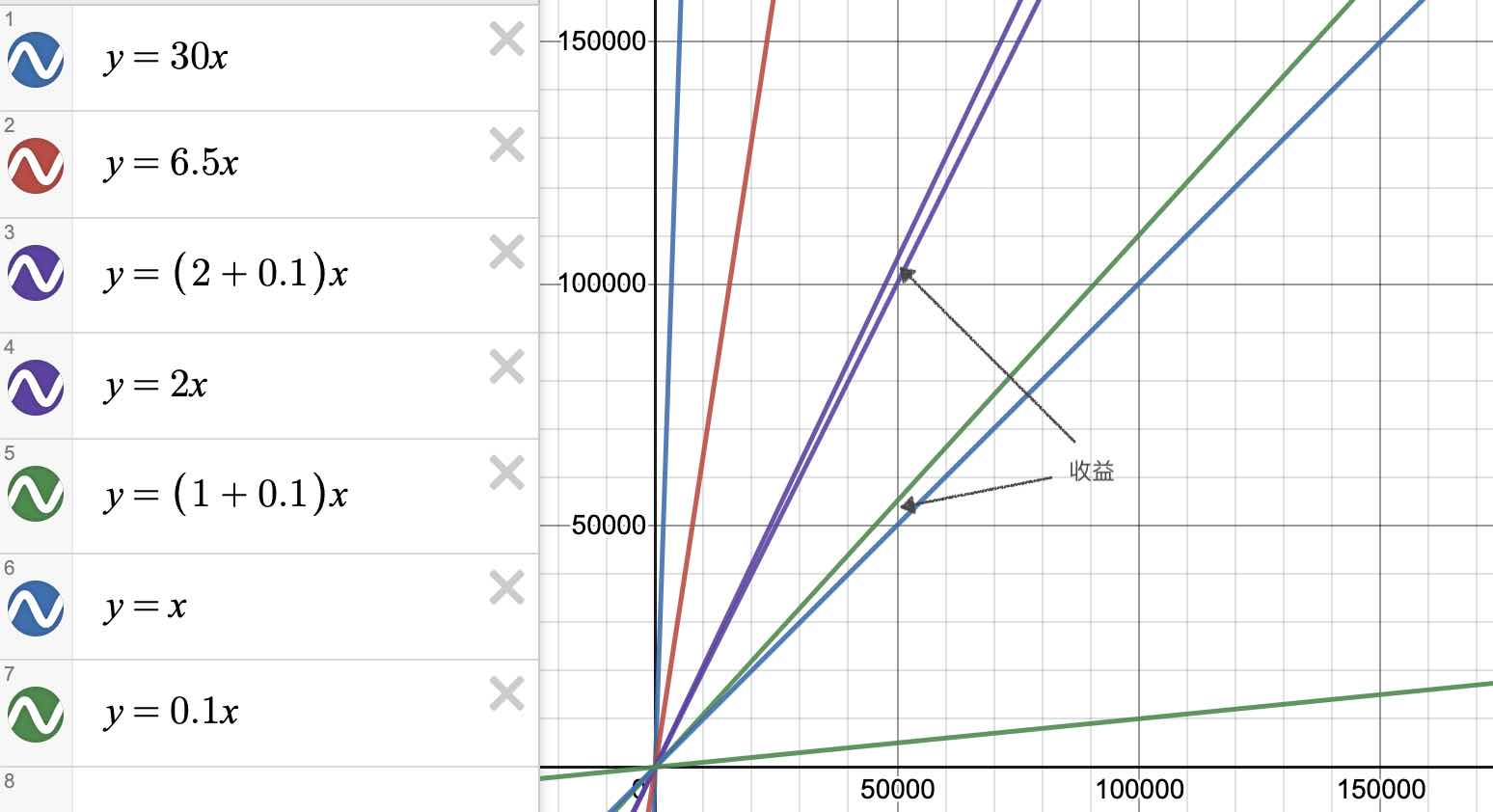
In the chart above, the x-axis is the original currency for exchange (e.g., USD), and the y-axis is the target currency.
- The first curve is Baht (1 USD to 30 Baht)
- The second is RMB (1 USD to 6.5 RMB)
- The fourth is a currency with exchange rate 2 (let’s say the currency name is Silver, 1 USD to 2 Silver)
- The third is Silver after the exchange rate increases by 1000 pips
- The sixth is a currency with exchange rate 1 (let’s say the currency name is Gold, 1 USD to 1 Gold)
- The fifth is Gold after the exchange rate increases by 1000 pips
- The seventh is the target currency change when pips is 1000
Because RMB and Baht curves are too steep to observe clearly. Let’s look at Gold and Silver’s profit changes under pips. At $50,000, when pips change by 1000, both Gold and Silver increase by 5000. However, we know that 5000 Gold and 5000 Silver have different values. That is, with the same $50,000 investment, the return rate is different.
For Gold, 1000 pips is a relatively large fluctuation; for Silver, it’s relatively small.
The steeper the curve, the larger the absolute number of daily fluctuations (pips). 100 pips is a very small fluctuation for Baht, but relatively large for RMB. 100 pips = 0.01
- For Baht, a 0.01 fluctuation is only (30.01 - 30) / 30 = 0.03%
- For RMB, a 0.01 fluctuation is (6.51 - 6.5) / 6.5 = 0.15%
From the chart above, using pip to represent exchange rate changes is not suitable for too flat exchange rates. For example, USD/THB = 30, then THB/USD = 0.033333 (1 Baht to 3 cents). If using pips for THB/USD:
- For a 100 pip change, it would cause (0.043333 - 0.033333) / 0.033333 = 30% exchange rate change.
So in this scenario, pip’s granularity is too large.
Currently there are three quotation methods for exchange rates:
- Direct quotation: How much domestic currency equals one unit of foreign currency
- Indirect quotation: How much foreign currency equals one unit of domestic currency
- US Dollar quotation: How much foreign currency equals one unit of US dollar (a few currencies, for example GBP, are exceptions)